12 Feb 2020 | Anthroposophy
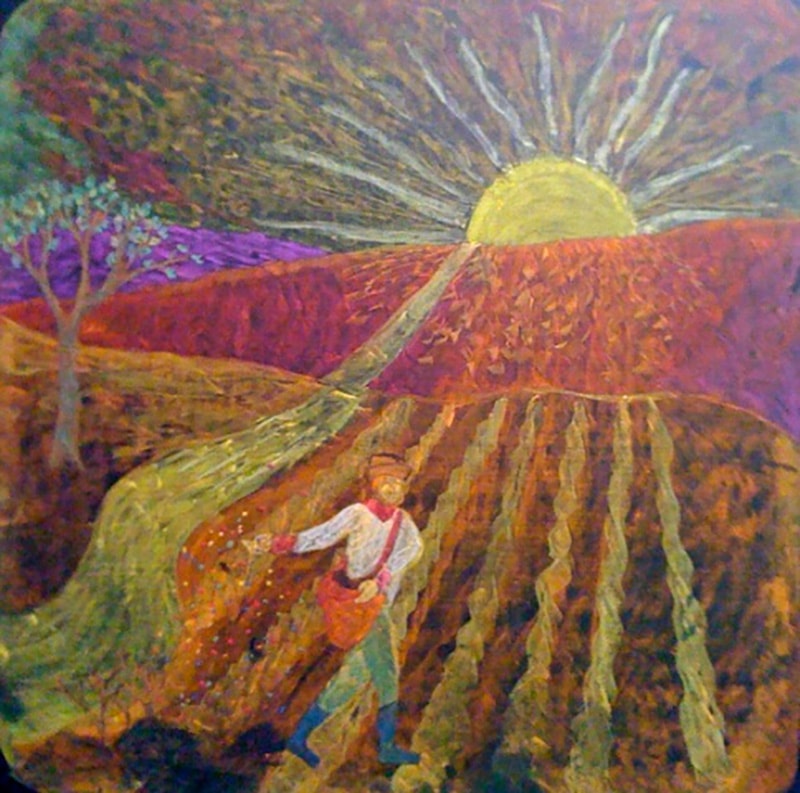
At the Waldorf elementary school in Alicante, the blackboard is a fundamental element because it serves not only to capture inside the contents that are being worked on in class., but also as illustration, in its external part, of images that have to do with the season of the year or the period that is being presented to the students (botany, history, farming, mythology, etc..)
The teachers of each class develop the art of capturing with colored chalk the images that will accompany the content in the classroom, narrations and periods of the year. A wonderful and artistic indispensable tool.
18 Oct 2019 | Anthroposophy, Education, Photos, News
“Books have value when they lead to life and are useful to it?”. Hermann Hesse
Something that usually happens when your children go to a Waldorf School is that their rhythm also reaches home and the rest of the family.. It arrives as an essential story before children go to bed, in special care when it comes time to eat, in giving a special value to play in children and art in primary…
Due to the interest of parents in delving into several of these topics, since last year we have a free library for members, workers and families.
The Library is located in the College store, the loans are for fifteen days (expandable if no one is waiting for that book) and their loan schedule is as follows:
mornings:
-Friday of 13:00. a 13:30h.
Afternoon:
-Monday and Friday of 16:00 a 17:00h. -Wednesday of 16:30 a 17:30h.
We hope that this service of the School will be of interest and use to you..
01 Mar 2019 | Anthroposophy, Education, Primary, Uncategorized
By Lourdes Alarcón Sevilla.
I am a student of Early Childhood Teaching at the University of Alicante Y, what's more, I am doing the training in Pedagogy Waldorf. Ambas things I'm doing them simultaneously.
In the three years that I have career, in the Degree of Education, Never with there was mentionado nothing about Waldorf pedagogy in class, and refers to others pedagogies, but of It isthis one specifically, many times, they were not even aware of it. Lor which one seems to me to show a lack of updating and research.
Thus, I was very surprised when the other day, in a subject related to psychomotor skills and movement, The teacher stopped to talk to us about the PWaldorf education and Rudolf Steiner, his thought and his work. Athe rest, He showed us videos in which the Alicante Waldorf School appeared, specifically a nursery classroom of 0 a 3 years during aper day. encouraged us to will allow children freedom of movement to experiment, to be surprised, investigate… Aof over He explained to us the importance of respect their stages of development Y no take them by thinking ahead of time.
I really liked hearing about this in class and seeing how the University encourages us to know and put it into practice.ta pedagogy and leaving education behind excathedra.
13 Feb 2018 | Anthroposophy, Education
To talk about childhood, let's invite memory to approach the sea on a sunny summer day, where on the beach the waves reach the end of their long journey. Images of children with their parents, grandparents, friends, waiting for this gift from the sea; laughing, Playing, receiving the waves with a jump, front or back, with eyes open or closed, fill the landscape with a unique joy, Of an ease and almost primordial innocence. there everyone, with and through children, we become children, we laugh with the wave and let it, in its roundness, push us, hit, find the acune. I have seen many adults acquire the lightness of childhood in these moments. It is the magic of the sea, with its constant curved line and its perpetual motion, inviting us to free ourselves from our rigidities and psychic structures that are too anchored, bringing out the child we were, the child that lives in us.
childhood is vitality, movement, play, laughter, smile, rhythm. The sea also smiles in the fullness of the wave, that rhythmically comes to play on the beach. Sea and childhood have a lot in common, let's learn from them.
The heart of childhood asks us for rhythm, play, movement, confidence, humor, art… all wrapped up in the clear image of what child development is, its evolution within the framework of human biography. Does this exist in classrooms? Do we offer children a learning space where they feel confident to unfold their potential when it has to flourish?? Do we teachers have the necessary perception to discover this inner dynamic of the child?? Does an educational system give us the necessary flexibility and freedom to accompany the child according to the perception we acquire of him?? Is the test battery, always looming on the horizon, a good criterion for evaluating the child? How much imagination and creativity does it take to assess based on exams? What is more appropriate for teaching in Primary, imagination or abstraction, the definition or characterization of the matter we present? a child of 4 O 5 years has to learn to read and write, one of the most demanding learning that the human being has to face, Or would it be more appropriate for him to use his time and strength to acquire other faculties appropriate to his age?? I have had students go through a process akin to torture when 4 and the 5 years were taught to read and write, they couldn't stand it, that is to say, they got sick. They came to the Waldorf school and were offered a space in the Kindergarten to continue growing as children.. There they regained confidence in the teachers and, later, in Primary, resumed the process of learning to read and write from the imaginative artistic, acquiring these skills without major difficulties. Where is the essence of the sea in the classrooms?
Make 100 years, Rudolf Steiner, the founder of Waldorf education, said that in education, at all times, you had to appeal to the feelings of the child. He also highlighted the constant and central presence of the artistic in teaching. These same principles are masterfully recalled today by Sir Ken Robinson in his educational work, where he denounces the rampant trend in recent decades to increase the scientific and academic content in the classroom to the detriment of the artistic field. It is art that marks the path to the inner journey in man, towards the experience, the experience, and with it the self-knowledge and the development of the personality. If we exclude it from the educational space we stop educating properly.
Rudolf Steiner told the teachers that they would have to accompany their class during the Primary journey. There would be no changes of tutor once the school year is over. There would be no textbooks, it would be up to the children and the teachers to create them. The first two hours of the morning would constitute a single block where they would be with the tutor teacher developing a theme throughout 3 O 4 weeks. there would be no exams, the teacher would be embarking on the journey of continuous assessment. The school would start by fulfilling the children 7 years. Teachers would have academic freedom and the ultimate responsibility to acquire a deep understanding of human nature and to be constantly creative in their classes..
Part of these basic principles of Waldorf pedagogy can be found today in an educational system that is viewed with respect and interest in its results.: finnish system. This has been occupying the first positions in the ranking of the PISA studies. The paradox is that while Finland is able to show the excellence of its system, in many countries that would have to change their principles and guide them in this direction, measures contrary to them are still insisted on: advance school age, don't abandon textbooks, do not extend the duration of classes, multiply the presence of exams and establish rigid programs, aiming at cognitive goals often unrelated to the child's age, regardless of the pace and experience aspect of learning. This road doesn't care about childhood, he doesn't take care of her, he does not perceive it in his nature, does not protect her, but it deteriorates it. Given these conditions, Is it still a surprise to talk about school failure?
 What are the roots of this pathology, more and more present in our time, demanding too much educational content too soon, to force a rote mechanical learning where the experience is absent? Why do you insist on seeing the child as a small adult?? In what dark cellars was this toxic potion of nonsense uncorked?? What mind remote from the origin wants to reduce the sea to the size of a pond or a swamp?
The game of the waves will not fail to awaken the smile and joy in the child because it will touch their essence. The dynamics of education must succeed in respecting childhood, in unfolding in each individual the unique potential that he carries in himself, in educating so that the child becomes a citizen with his own thinking, attentive to the challenges of his time, aware of the profound dimension of existence. The Waldorf pedagogy works with these ideals and dedicates all his effort to them. There is no human enterprise that has higher goals than education.
Jesus Lopez
Teacher at the Waldorf School of Villafranqueza, Alicante.
Ken Robinson (Liverpool, England, 4 March 1950) he is an educator, British writer and lecturer. Doctor from the University of London, Robinson is considered an expert on matters related to creativity, the quality of teaching, innovation and human resources. Due to the relevance of its activity in the fields mentioned, especially in relation to the need to incorporate art classes into the school curriculum, was appointed Sir by the queen of England, Elizabeth II in 2003.
14 Dec 2017 | Anthroposophy, Education
"From the description we made, we know that, with the arrival of autumn, an inhalation takes place, truly spiritual inhalation of the Earth: are being sucked into the lap of the Earth, the elemental beings who have found their way out in the summertime, that then go back when Micael's party arrives, and they continue to recede further and further, until, in the height of winter, reach their most intimate link with the interior of the Earth.
From all of this, we can form the idea that, precisely in winter, Earth is a more contained entity, more closed in itself. From the universe he has collected everything spiritual that he had projected out during the summer. So, during the fullness of winter, is when the Earth is more Earth, when it reveals its true substantiality ".
Text taken from Rudolf Steiner's book of lectures :"Coexistence with the cycle of the year in four cosmic Imaginations"
Learning to see life and the celebration of parties from its external and internal part helps us to see how matter and spirit complement each other even though to the mind they seem like contradictions..
Where is life on Earth in spring? Outside, manifests itself on the outside of your Earthly Body. Has exploded the inner life, It has been launched outside and we can observe the manifestation of that explosion in the beautiful colors and in the greening of the plants.. And what happens inside the Earth?... that remains empty!!... and in the summer this emptying of vital forces culminates. Life, fullness outside. Death, empty inside.
Where is death, the empty, and life in winter? Outside everything is paralyzed, lifeless. In real winter areas this is more evident than in the Mediterranean. However inside the vital forces of the Earth fill it, are silently held within her, they await sheltered and protected the next spring demonstration; the interior is very active, full of life. A) Yes, matter and spirit are together in winter, when we celebrate christmas. Earth is more Earth.
The same process is also evident in humans. If we are totally out delivered to the light and nature, inside inside us, we are empty. Breathing out our inner manifestation we are left inside without spirit, we sleep inside ... but, How beautiful is the exhalation of our soul in summer, like the exhale of the earth! ... necessary for vital rhythms is that soul breathing ... and now in winter, In Christmas, how beautiful to inhale our soul, our soul life and our spiritual element, our individuality, our Self and live internally the non-material qualities of our Being.
A unique possibility offers us winter with the Christmas festivity, caring for and living in this time with inner fullness our highest ideals in human relationship ... because every year, in this winter time, at Christmas ... the Human Being is more Human Being.
For Mari carmen garcia.


