Dynamics in the Waldorf curriculum
Friday 5 March 2021.
The next Friday 5 of March, of 15 a 16 h., We will offer a face-to-face talk so that you can learn about the Waldorf primary curriculum. You can confirm attendance at info@waldorfalicante.com
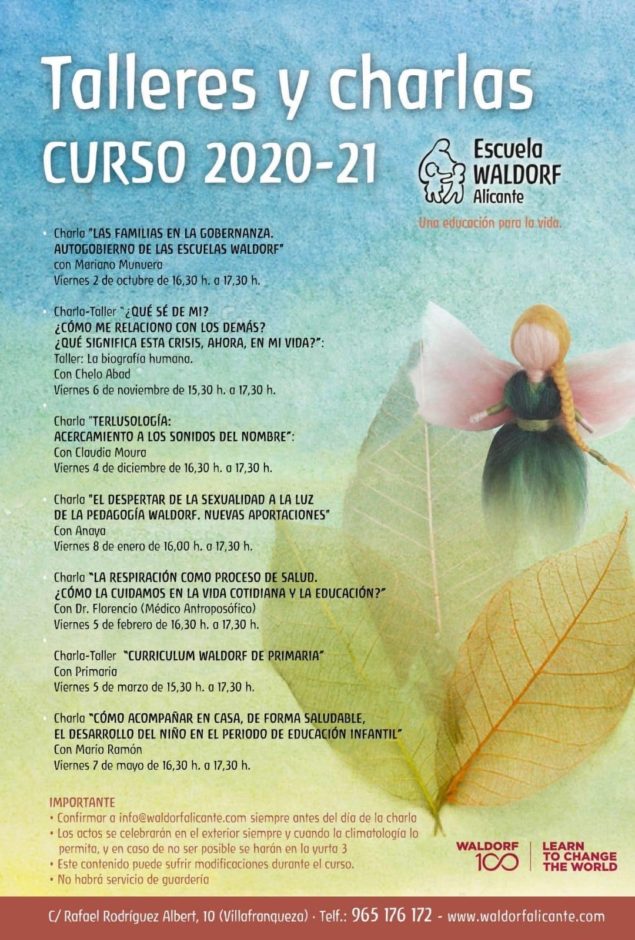

The next Friday 5 of March, of 15 a 16 h., We will offer a face-to-face talk so that you can learn about the Waldorf primary curriculum. You can confirm attendance at info@waldorfalicante.com
There are experiences that accompany you throughout your life ...
The 10-11 years are the heart of childhood, a period of harmony prior to the arrival of adolescence. In Waldorf schools it is accompanied by immersion in the world of classical Greece, their mythology, your science, his art, Homero, Socrates, Alexander the Great ... Throughout the course those images accompany us in narrations, theater plays, songs, verses ...
The final part of this tour is a meeting of the 5th grade classes of Waldorf schools in Spain and Portugal in Ampurias, to participate in an Olympics in the magical setting of the ruins of a city, first Greek then Roman. Athletes are tested in jump, carrera, struggle, javelin and discus, not to be first, but in search of his gestures of the ideals of Beauty, Truth and Strength, not to outperform others or to seek the best result, but to find yourself in the process of giving your best.
The stone remains of the amphitheater and the arena of ancient Emporiae bear witness to the experiences of these children, dressed in their robes, representing Sparta, Athens, Delfos, Eleusis or Thebes. The ruins bear witness to the resurgence of the Hellenic ideal in them, in those pure experiences of themselves, of his strength, of its harmony, of her perfection ... you can see it in the brightness of her eyes, in the determination of his gaze, in the fluidity and speed of actions, in the passion of their movements… Everyone has reached perfection at some point, the memory of that leap they took is engraved in their souls, how his partner managed to throw the javelin like never before, how his partner managed to finish the marathon test and they hugged him at the finish ...
They return as victors, but without losers, victors of themselves, enriched and transformed by the Beauty experience, Truth and Strength, for the authentic experience of themselves and their companions on an unforgettable trip, fruit of past experiences and seed of others that are yet to come.
Juan Luis Alegria Ibáñez. Waldorf Alicante School. IIP Dharma College Alicante.

“In a world of plastic and noise, I want to be made of mud and silence” Eduardo Galeano.
For a few decades, a great industry has been emerging around childhood. An industry in which I wonder if there is too much "plastic and noise" and little "mud and silence", little space to be yourself, for that conscious place, happy, warm and simple that I feel my children need to grow. The first time I stepped foot in a Waldorf Kindergarten, I saw a sunny corner with a fertile and beautiful environment, suitable to take care of the first sprouts of the seeds that will be the women and men of tomorrow ....
It was clearer to me when my four-year-old daughter met her teacher, the first day of class. He crouched down to her height, He looked into her eyes with a radiant smile and opened his arms. My daughter got closer to her little by little until they hugged each other.. "How I wanted to meet you and what a good time we are going to have a good time! ”, Told him. At that moment I felt very excited and grateful that someone received her in that way, a welcome full of illusion, of affection and conscience on the path they were going to travel together. Although parents can stay in the period of bonding with the children, in our case it was not necessary, that moment was enough to awaken the confidence and security that a child needs to feel at home in Kindergarten.
From this garden my daughter does not bring homework, but the pockets full of treasures: piñas, palos, seeds, dry leaves ... It also brings drawings, all different, full of colors, of lines, of fantasy, with the date and name carefully written by your teacher, as if wanting to remind us that they are important and that we keep them for them.
In this Garden there are no notes or reports on whether the letters are known, the numbers or the colors. The teacher tells me if she has been happy or talkative, if you seemed sleepy or if you haven't had a good day. He tells me with sincerity and lightness the anecdotes and the conflicts, their encounters and misunderstandings, your achievements and unfinished business, but without labels, with confidence in their strengths and open to the wonderful capacity for transformation and change that children have.
In the south it rains little, but when it does, Kindergarten is a great party where, well covered with their boots and rain bibs, the little explorers happily enjoy the magic of the wet earth and the music of the puddles.
In this Garden the “Cantajuegos” does not sound nor are there digital blackboards, the voice of their teacher and her presence is like the water of an inexhaustible source of melodies from which the children drink every day. Popular songs, pentatonic, according to the time of year, also of rhymes and finger games, that later at home they hum without stopping.
From this Garden my daughter brings phrases full of force, that have become frequent sayings in our day to day as a large family: "To whom it is his turn, touch, luck is not wrong "he says when there is conflict over the blue glass. "One can have a little while to get angry", says when something irritates him.
In this garden, the breath and the rhythm of the morning is harmonious and complete, protecting children from the intellectual burden that is already common at these ages. One day I had to go early to pick her up and she didn't want to leave without listening to the story, the narration with which they end each day, which is like that delicious dessert after a healthy meal, but that in this case feeds his inner world.
For these and other experiences, I am convinced that the first shoots of our daughter are accompanied by experiences that she treasures in her heart. I trust that they are forces and impulse so that , also in his adult life, can be herself.
Carmen Saura, mother of the Waldorf School of Alicante.

Friday 31 from January, at 16:30 hours at the Alicante Waldorf School.
We want to invite you this Friday 31 to a meeting to learn about the concretions of the primary school project for the next academic year 2014-2015. We will inform you of the process we are carrying out and how this precious seed grows.. We will also talk about the legal situation of the project, the foundership, and enrollment for the next course. We will start at 16:30.
There will be childcare 16:30 a 18:30 h.
Primary and Growth Group.

In the second dentition the child enters into imaginative life! Not intellectual!, but in the imaginative!. And educators and teachers, They have to know how to develop it.; but only those who have a true knowledge of man can achieve it; the knowledge that unfreezes the inner psychic life and makes a smile appear on the lips.
Imaginatively, this is how to educate between the second teeth and puberty. We could say that, on the first years, the child's characteristic of being all sensory organ, is internalized and oriented in the soul.
In this way the sensory organs form images of external objects., soul images, not thoughts. The boy, since the beginning, makes artistic sense, creative fantasy, you have to appeal to her, you have to go to her.
Take for example the teaching of writing. A child has no relationship, Let's say, with an A. why should i have it? Why should he be the least bit interested in an L? Those letters say nothing to him and, nevertheless, when the child enters school, he is harassed to learn them. The consequence is complete disregard for what he is required to do..
And yes, to top, you are introduced to that strange world before the second teeth, suggesting that you place letters in pre-cut molds, the child is related to completely unrelated things, who have not the slightest affinity with him.
If we appeal to the artistic sense and creative fantasy, the teacher should seek, for example, for each sound an image and an inventive pictorial representation, the teacher will find images for all consonants and develop them by drawing painting.
These images or pictorial representations can be introduced by the teacher through a story, in which the image appears that will later be painted on the blackboard and from which the letter will be extracted.
For example

In relation to vowels, it would be more advisable to seek a relationship with a mental experience, and with gestures that our soul and our hands do to express or externalize said experience.
If we think of the O: something is embraced lovingly and from this gesture the symbol O is developed. Of the gesture, of the gesture, it is possible then to create the five vowels. that's the way; appeal to direct intuition, to fantasy, and little by little get the children to derive from things, the sounds, the letters, that is to say, that start from the image.
But the parents complain saying: Children learn to read and write very late. This comment implies ignorance of how harmful early learning to read and write is for them.. It is a curse to know how to write too soon. It is also necessary to know and categorically understand, above all that the teaching of reading should not precede that of writing.
In writing when drawing is derived from painting, of painting drawing, the whole man comes into action, cooperating fingers, the position of the body and of the whole man.
should be postponed as long as possible, those activities in which only part of your body is involved, leaving the rest idle. The most important thing is that first the whole man goes into motion and then the part.